
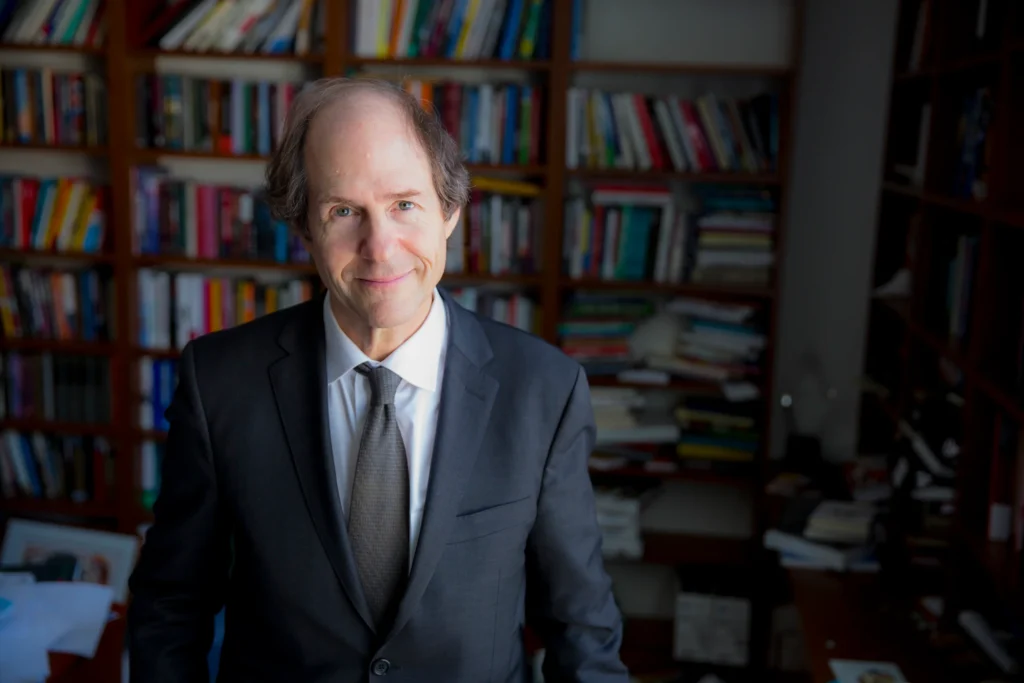
A Conversation with Professor Cass Sunstein about his new book On Liberalism in Defense of freedom
1 Biographical question
1) Professor Sunstein, I would like to congratulate you on the writing of your excellent new book with fundamental insights into the liberal tradition. While reading it, particularly chapter 8 on opportunity and liberalism I noticed your admiration of Rawls’s original position in a Theory of Justice. On this note, how important has been John Rawls’s work on your intellectual trajectory? And how do you feel about teaching at Harvard where Rawls, Sen and Arrow were at the center of some of the most significant debates of the last century?
Thank you so much for the kind remarks. Rawls has been fundamental to my thinking. I first read him when I was about 18 years old, in a college class, and he became a friend over the years, which was very lucky. I consult his work frequently. His ideas about justice have helped orient my own. On teaching at Harvard: It is a true blessing. I know Sen very well – we have taught together – and he is a hero of mine. So is Arrow, whom I was privileged to know also.
2 & 3 What is liberalism?
2) One of the major challenges in the human sciences—including philosophy—is dealing with the contingency of concepts and the risk of anachronism. Concepts evolve historically; for instance, the notion of freedom in antiquity is not precisely the same as in later periods. In this light, how can we arrive at a definition of liberalism that avoids falling into anachronism?
Here’s a concept: Gravity. Dropped objects fall. I am not a scientist, but the definition is stable enough. Here’s another: Love. You can read literature from long ago, and love is, well, love. Liberalism is a set of ideas. It changes over time, no doubt about that. But freedom, the rule of law, and pluralism are the holy trinity, and we don’t fall into anachronism when we identify them as such.
3) With your vast experience as a legal scholar, especially in the field of constitutional law, and speaking concisely, what have been the most substantial contributions of liberalism to the field law? And, along the same lines, how can we establish a fruitful relationship between economic and political liberalism or between constitutional law and a pro-market economy that is, at the same time, capable of addressing the negative externalities of the market?
The most substantial contribution of liberalism is, I think, the rule of law, but you could say that it is tied with the commitment to freedom of speech and freedom of religion. Liberals also like private property and free markets, but they believe in an assortment of strategies to deal with externalities: regulation, corrective taxes, nudges. Of course liberals disagree with one another about the best approach. The good news is that there is a lot of helpful liberal thinking on how to deal with (for example) dirty air and dirty water.
4 & 5: Questions on Equality, Liberty, and Freedom of Expression
4) In the chapter on Being a Liberal, you demonstrate that liberals are committed to individual dignity, emphasizing the notion of agency and relating it to two central historical figures: Mill and Lincoln. Considering this, how can the idea of agency become a practical political tool for today?
A big question! Here’s part of the answer: Careers open to talents. Let people see how far their talents can take them. The idea of dignity has a host of implications. People should be treated as ends, not means, and as subjects, not objects.
5) One of liberalism’s great achievements in the realm of ideas has undoubtedly been freedom of expression. However, in the face of contemporary political problems, this ideal has often been called into question in the name of truth. The issue is that people frequently fail to distinguish between falsehoods propagated by authorities and fallibilities inherent in public discourse. In this context, how can we differentiate falsehoods stemming from abuse of authority from legitimate interpretive errors?
If you believe in freedom, you will allow people to say false things. We regulate lies with social norms, not with law. True, some lies can be stopped: commercial fraud, perjury, tax fraud. Dealing with lies by politicians is a work in progress, and liberals have different views about how to handle the problem.
6) In your view, Professor Sunstein, why should we return to reading Mill and Hayek in order to fully understand the liberal tradition? What insights from these two great thinkers can help us reflect on the dilemmas we face today?
Mill was the great theorist of liberty. We can start with his celebration, in On Liberty, of letting people go their own way. It can orient government practice. Mill had a lot to say that conformity and the bad things it does. Miil was also the great theorist of sex equality, and we could use a bit more of that. Hayek was the great critic of government planning, emphasizing that planners cannot possibly know enough to play well. Hayek’s arguments bear on many current debates, including debates over environmental regulation and regulation of labor markets. I should say that I certainly don’t agree with Mill and Hayek on everything, but all of us can learn from them.
7. Question: Democracy and Freedom
7) Professor Sunstein, in the Fire and Hope epilogue, you describe liberalism as a youthful force—marked by its energy against cruelty and its appreciation for human agency. In light of the current attacks on democracy and liberty, do you believe we are facing a structural crisis of political and economic liberalism, or is this a somewhat mistaken reading by certain political analysts?
It can be very hard to know what you are in the middle of, when you are in the middle of it. The answer to your question will be a lot clearer twenty years from now than it is today. The most I can say is that there is some risk that we are in a crisis, and it’s not small. Of course I hope the risk will not come to fruition. I would add that I am an optimistic by nature, and so I think that things will work out well, as I hope.
Photograph by Rose Lincoln