Why Is Russian Literature Great?
By Guilherme Giovaneli
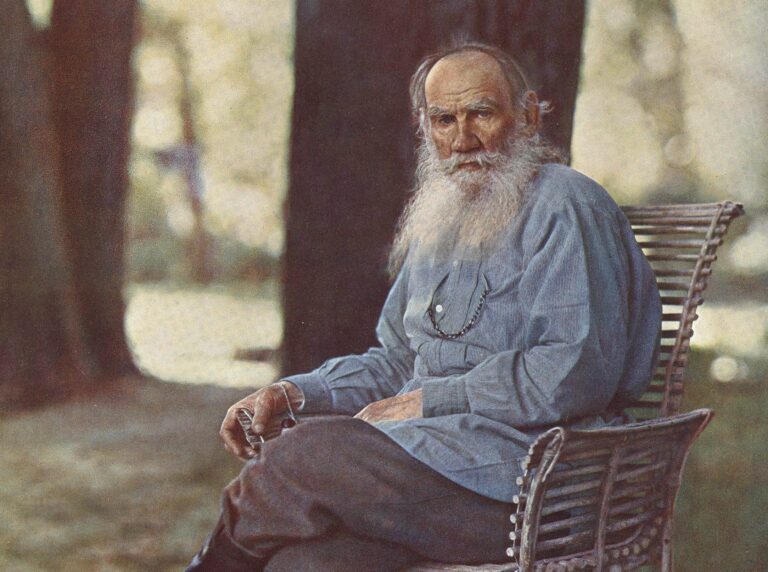
From the nineteenth century to the present day, the tradition of Russian literature, above all in narrative, has produced a body of classics cherished throughout the world. Even those who have never read a single line of Ivan Turgenev, Leo Tolstoy, or Anton Chekhov nonetheless carry a familiar image: the Russian novelist as a bearded figure, serious, with a piercing gaze, capable of dissecting the human soul with almost surgical precision, acquainted with all our greatness and all our miseries. In this essay I reflect on the causes of this nearly unanimous recognition of Russian literature’s greatness.
It has become a commonplace that the nineteenth century was an age of revolutions. Cities expanded, social mobility accelerated, and truths that had endured for nearly a millennium ceased to be taken for granted. Nowhere was this transformation more emblematic than in France. The feudal system, with its rigid assignment of social roles, had been shattered by the French Revolution, which proclaimed that social origin no longer determines a man’s destiny, inasmuch as he is born free and equal to all others. This new possibility of mobility in the social world created a peculiar atmosphere in French life, as the novelist Stephen Vizinczey1 observed:
“In France the upheavals of the Revolution, the Napoleonic conquests, defeats and final debacle and the Bourbon restoration raised people high and cast them low with the drastic swiftness of great drama; dukes became coachmen, coachmen became dukes, the official truth changed by the day, and the best minds were curious to know how it all came to pass.”
To represent this emerging society, French literature had to develop new means, building upon the accumulated resources of the literary tradition. It is in this context that the French modern novel emerges. Honoré de Balzac constructs intricate plots mirroring the complex structure of the social fabric. Stendhal deploys psychological acuity to reveal the gap between inner life and spoken dialogue. Gustave Flaubert synthesizes both: Balzac’s complexity of plot and Stendhal’s psychological density are fused into a narrative architecture in which the omniscient narrator recedes and the world is presented from the interior perspective of the characters, even in the third person. The French novel, as a form, is born to represent a dissimulated society. The psychological density of inner monologue in Flaubert, for instance, is not merely an aesthetic ornament. It is the literary equivalent of social duplicity, the distance between intention and speech.
Flaubert, more than any other writer, reveals the moral catastrophe latent in a society that believes in the perfect indeterminacy of the individual. In Madame Bovary, Emma Bovary imagines herself a romantic heroine. A provincial housewife, she seeks fulfillment in adulterous adventures. The result is devastatingly ironic: Emma commits suicide; her husband dies of grief; their daughter is sent away to grow up in poverty. Flaubert is one of the deepest writers who ever lived. Yet in Madame Bovary his depth is purely descensional. It reveals the dimension of human fall, without being open to redemption.
It is from this French inheritance that Russian writers produced some of their most powerful fiction.
At first glance, the similarities between nineteenth-century Russia and France invite comparison. As Vizinczey2 notes, Russian society too lived with a pervasive sense of impermanence:
“There must be more reasons for this than we could fathom, but I suspect that the development of Gogol, Dostoevsky and Tolstoy had a great deal to do with the all-pervading sense of the impermanence of the Russian way of life, shared even by the Tsars, and with the large number of educated, leisured but impoverished noblemen and doubting monks who were ready to listen to new answers to every question. There was a hunger in Russia for all sorts of panaceas — most of them deadly — but also for the truth.”
The event in Russia roughly analogous to the French Revolution was the Emancipation of the Serfs in 1861, proclaimed by Tsar Alexander II of Russia. This decree ended centuries of servitude, freeing peasants from their immediate social determinations and inaugurating a crisis in the Russian aristocratic order that would culminate in the revolutions of the twentieth century. Even then Russians sensed the instability of their world. Revolutionary ideas circulated, nihilism spread, and political terrorism was not uncommon.
Yet despite this apparent similarity with France in political instability, there remained a decisive difference: the persistence of the Christian dimension.
While France moved steadily toward secularization, Russia preserved a distinctly Christian sensibility. One of the most characteristic Christian experiences, and one that became central in Russian literature, is the awakening of consciousness before death.
Christian teaching holds that even a life spent in sin may be redeemed if, in its final moments, the soul awakens in painful recognition and repentance. Through such recognition – an anagnorisis, as the Greeks would say – the entire life may be retrospectively transformed in the light of eternity. A sentence attributed to Saint Teresa of Ávila expresses this spirit succinctly: “Life passes so quickly that we ought to think more of how to die than how to live.”
Curiously, one of the great literary representations of this experience appears in a work by another Spanish author: Don Quixote, by Miguel de Cervantes. The novel begins when the minor nobleman Alonso Quijano, after reading too many romances of chivalry, loses his sanity and decides to become the knight-errant Don Quixote. The book’s structure is predominantly comic and its atmosphere ironic. Yet at its end Quijano returns home, falls ill, and recognizes that he was never a knight, understanding with painful clarity that his life was built upon illusion. Alonso Quijano becomes a grave man. Conscious of life’s irreversibility, he now accepts death serenely, and the redemption of his soul. A life of illusion is transfigured in the presence of eternity.
This experience – the painful recognition that one’s life has been a lie, combined with the opening toward redemption – is one of the main motifs of Russian literature.
The Russians absorbed from the French the narrative techniques and the representation of human fall. But they added something more: the possibility of ascent, of redemption. Thus the moral imagination of the nineteenth-century novel acquired a full vertical dimension, from descent to ascent. This is the decisive contribution of Russian narrative. It explains why George Steiner could write that “Russian literature mirrors the coming of the apocalypse”, and why Virginia Woolf remarked that “the soul is the chief character in Russian fiction.” Russian fiction is eschatological precisely because the individual soul abandons the illusions of the social world and opens itself to eternity.
The examples are numerous. In First Love, by Ivan Turgenev, the young protagonist falls in love with a woman who instead becomes involved with his father. Both later die. Were the story to end there, Turgenev would be merely Flaubertian. Yet the novella concludes with the protagonist contemplating the death of a poor old woman and feeling a powerful impulse to pray – for his father, his first love, and himself. This movement toward transcendence is fully explored by Leo Tolstoy in The Death of Ivan Ilyich. A bureaucrat suffers a seemingly trivial domestic accident that leads to a fatal illness. In agony, he gradually perceives that his life has been a sequence of illusions and lies. Only at the end does the possibility of redemption appear. The text implies that Ivan Ilyich attains the beatific vision. Something similar occurs in Anton Chekhov’s Rothschild’s Violin. The protagonist realizes, near death, that he has mistreated his wife, lived cruelly, and squandered his life. Only then does repentance become possible.
All these narratives employ the techniques perfected by French fiction: psychological rhythm, interior monologue, subtle narrative structure. Yet unlike the tragic closure of Flaubert, they open toward transcendence. After the fall – lies, illusions, and misery – the possibility of redemption is suggested.
In his essay on Tolstoy, Matthew Arnold3 wrote that “The Slav nature, or at any rate the Russian nature, the Russian nature as it shows itself in the Russian novels, seems marked by an extreme sensitiveness, a consciousness most quick and acute both for what the man’s self is experiencing, and also for what others in contact with him are thinking and feeling”. This sensitivity helps explain the singular power of Russian fiction. Russian writers lived in a society where the tension between individual and community was acute enough to generate complex psychological drama, yet where the Christian imagination still preserved the language of repentance and openness to transcendence.
Russian literature is great because, using the technical resources of the modern novel, it offers a complete vertical map of the human soul: from the fall – lies, illusions, self-deception – to the ascent – repentance, charity, conversion and mystical ecstasy. Writers such as Turgenev, Tolstoy, and Chekhov reveal the human soul in its depth, and remind us of the eternity toward which it longs.