Homer’s Iliad: Literature and the Moral Imagination
When we speak about the function of literature and the purpose of literary culture in the human mind, two aims are usually invoked – seemingly opposed, yet not truly incompatible. The first is literature as an art form. In the nineteenth century, a way of classifying certain human creations emerged: certains works served no obvious utility other than offering some sort of aesthetic delight. The word aesthetic, of course, comes from the Greek aisthesis – “sensation.” At first glance, the common factor linking such heterogeneous activities as painting, sculpture, and literature is precisely this aesthetic effect: the evocation of sensations and images in the external and internal senses of the one who beholds them.
A second conception treats literature as a means of transmitting values. Since ancient Greece, what we now group together under the name “the fine arts” carried an unmistakably pedagogical meaning: they were meant to shape the moral imagination. This was particularly true of the whole body of works we call “Greek literature.” The epic poems of Homer and Hesiod, the tragedies of Aeschylus, Sophocles, and Euripides, and the comedies of Aristophanes were all seen as witnesses to Greek ideals – expressions of the moral imagination of the polis.
These two views, however, do not contradict each other. The beauty of a work – its aesthetic force – is precisely the means through which it reveals the human condition: the tensions between what we hope to be and what we actually are. This, after all, is how the Iliad was understood for generations, long considered the chief vehicle of Greek values.
In order to understand the relation between literature and moral life in the Iliad, one must first comprehend certain assumptions of Homer’s world. The German philologist Werner Jaeger, in his classic Paideia: The Ideals of Greek Culture (1934), identifies aristeia as one of the core values of Greek civilization. Greek heroic ethics were, above all, aristocratic. Hence the notion of aristeia: a form of excellence, a magnanimity of soul that sets the hero apart from ordinary men. As Jaeger explains, “The Greek nobles believed that the real test of manly virtue was victory in battle – a victory which was not merely the physical conquest of an enemy, but the proof of hard-won areté. This idea is exactly suited by the word aristeia, which was later used for the single-handed adventures of an epic hero. The hero’s whole life and effort are a race for the first prize, an unceasing strife for supremacy over his peers.”
If heroism presupposes a noble adversary – since there is no glory in defeating the weak – then only a valuable opponent can confirm a hero’s worth. To conquer an excellent foe is to be excellent oneself. Thus, as Jaeger notes, the representation of aristeia – which culminates in the triumph of one renowned hero over another – constitutes the most ancient form of greek epic fiction.
In this sense, the Iliad is a portrait of the Greek ideals, and an example of how aesthetic experience embodies the tension between values and human circumstances. Using Robert Fagles’s Penguin translation, we turn to the opening of the poem. A common cliché claims that the Iliad is “about the Trojan War.” The action indeed unfolds during the war, but the poem’s true subject – declared in the first line – is the wrath of Achilles.
Achilles, one of the greatest Greek warriors, is drawn into conflict with Agamemnon, leader of the Greek host, after Agamemnon seizes Briseis, Achilles’ war prize and slave, to replace his own. Achilles withdraws from battle, and his absence brings great losses to the Greeks. Eventually, his beloved companion Patroclus is killed by Hector, prince of Troy.
Homer, with his brilliant epic point of view, also shows us Hector’s perspective. Hector is portrayed as a courageous warrior, so much so that in the Middle Ages he was ranked, alongside Alexander the Great and Julius Caesar, as one of the greatest pagan exemplars for Christian knights. Yet one of the most moving scenes of the Iliad is not martial, but domestic in nature: Hector’s final farewell in Book VI to his wife, Andromache, and their infant son, Astyanax.
“In the same breath, shining Hector reached down
for his son-but the boy recoiled,
cringing against his nurse’s full breast,
screaming out at the sight of his own father,
terrified by the flashing bronze, the horsehair crest,
the great ridge of the helmet nodding, bristling terror –
so it struck his eyes. And his loving father laughed,
his mother laughed as well, and glorious Hector,
quickly lifting the helmet from his head,
set it down on the ground, fiery in the sunlight,
and raising his son he kissed him, tossed him in his arms,
lifting a prayer to Zeus and the other deathless gods:“
The scene is tender: the child recoils in fear at the sweeping horsehair crest on Hector’s helmet, prompting both parents to laugh. Hector removes the helmet – its bronze flashing – and embraces his son for the last time. Here Hector is not only a warrior, but a husband and father. As Erich Auerbach said in his Mimesis: The Representation of Reality in Western Literature (1946), “Homer, of course, is not afraid to let the realism of daily life enter into the sublime and tragic.” By showing us this scene, Homer prepares the emotional force of Achilles’ later wrath. When Achilles learns of Patroclus’ death – his brother-in-arms and closest companion – he returns to battle in a frenzy, kills Hector, and, in his rage, desecrates his body, dragging it around the walls of Troy:
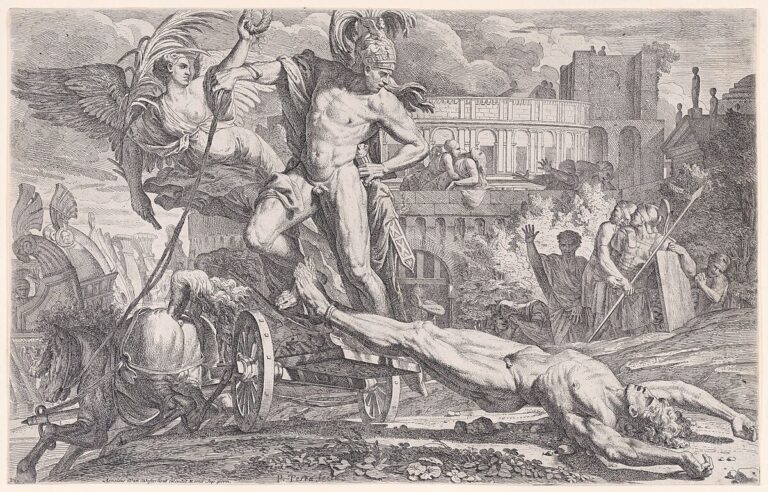
“So he triumphed
and now he was bent on outrage, on shaming noble Hector.
Piercing the tendons, ankle to heel behind both feet,
he knotted straps of rawhide through them both,
lashed them to his chariot, left the head to drag
and mounting the car, hoisting the famous arms aboard,
he whipped his team to a run and breakneck on they flew,
holding nothing back. And a thick cloud of dust rose up
from the man they dragged. his dark hair swirling round
that head so handsome once, all tumbled low in the dust –
since Zeus had given him over to his enemies now
to be defiled in the land of his own fathers.“
The image of Hector’s body – once a noble warrior, husband, and father – now dragged and vilified in filth and dust is devastating. The Trojans weep “as if all Troy were torched and smoldering down from the looming brows of the citadel to her roots.” Achilles’ act is not merely violent; it breaks the very code of aristeia. By denying Hector the funeral honors due to a worthy enemy, Achilles denies his own value as a warrior. For the Greek hero, the logic is simple: a dishonored adversary dishonors the victor as well. “So he triumphed and again he was bent on outrage, on shaming noble Hector.” Achilles’ own rage debases him. As Apollo later says in Book XXIV, Achilles has become like a mindless lion – fierce, strong, but lacking the disciplined excellence that defines true virtue:
“But murderous Achilles-you gods, you choose to help Achilles.
That man without a shred of decency in his heart…
his temper can never bend and change-like some lion
going his own barbaric way, giving in to his power,
his brute force and wild pride, as down he swoops
on the flocks of men to seize his savage feast.
Achilles has lost all pity! No shame in the man,
shame that does great harm or drives. men on to good.“
Here we can see how, in Homer, ethics and aesthetics – the tension between the ideal and the real, on the one hand, and the creation of beautiful images on the other – come together. The figure of thought employed, a simile that draws an analogy between Achilles’ actions and those of a fierce lion, is an example of the procedure inaugurated by Homer and later consecrated in Western literature as the “epic simile.” The function of an epic simile in narrative is to momentarily eclipse the main action, creating a brief digression that compares it to an image that amplifies its meaning. Like the fierce lion, Achilles was no coward; but his ferocity was no longer the courage of heroes – the nobility of spirit that immortalizes their deeds and makes them models of excellence. Achilles had debased himself, becoming akin to a beast; his power was no longer the dynamic harmony that constitutes virtue for the Greeks, but rather an instinctive and untamed, savage impulse. It is particularly suggestive that this comparison comes from the mouth of Apollo, a deity associated with balance and harmony – values that for the Greeks were simultaneously ethical and aesthetic. Long before Aristotle composed his ethical treatises, the elegiac poet Theognis of Megara (507–485 BC) had already proclaimed: “Do not go to excess: the best lies in the middle; and by remaining in the middle, you shall attain virtue.”
Achilles, thus, has undergone a moral and even ontological fall: he ceased to be a hero and became a wild beast. Yet in one of the most sublime moments in Western literature, King Priam of Troy appears before him in tears, kissing Achilles’ hands and begging for the body of his son Hector, so that he might grant him the proper funeral rites. Priam does not appear as a weak man consumed by resentment: rather, he recognizes Achilles’ excellence, his virtue, his aristeia – and therefore Achilles, in turn, recognizes the old king’s magnanimity. Achilles returns the body of Hector – and in that gesture recovers his own humanity and heroic stature.
The scene in which Achilles and Priam contemplate one another after sharing a meal is charged both morally and aesthetically:
“They reached out for the good things that lay at hand
and when they had put aside desire for food and drink,
Priam the son of Dardanus gazed at Achilles, marveling
now at the man’s beauty, his magnificent build –
face-to-face he seemed a deathless god…
and Achilles gazed and marveled at Dardan Priam,
beholding his noble looks, listening to his words.“
In this scene, in which one character contemplates the other, we witness one of the earliest attempts to articulate character-based point of view within the Western narrative tradition. The English literary critic David Lodge, in his The Art of Fiction (1992), reminds us that a narrative may offer different perspectives on the same event – though only one at a time – and that even when the narrator reports events in a nearly omniscient manner, as is the case with the Homeric narrator, the point of view of certain characters may nevertheless be privileged. Such is the case in this passage: it is Priam who marvels “at the man’s beauty,” thinking that “face-to-face he seemed a deathless god,” and it is Achilles who “gazed and marveled at Dardan Priam, beholding his noble looks, listening to his words.” This subtle transition between the point of view of the narrator inspired by the Muses, who recounts the events, and the point of view of the characters, who contemplate each other’s nobility and magnanimity, anticipates the use that the French novelist Gustave Flaubert would make nearly two millennia later of the narrative technique known as “free indirect style,” for example in the scene from Madame Bovary – here quoted in Lydia Davis’s translation, published by Penguin – in which Charles contemplates Emma’s fingernails and the narrative shifts smoothly into the husband’s perspective: “Charles was surprised by the whiteness of her fingernails. They were glossy, delicate at the tips, more carefully cleaned than Dieppe ivories, and filed into almond shapes.”
Returning to the Homeric poem: it is through narrative technique that the mutual recognition of excellence between the Greek hero and the Trojan king is revealed, and it is through imagery that Homer discloses the tension between the ideal and the real. Homer, by means of his fictional art, narrates how a courageous yet impetuous Greek hero like Achilles would act and feel under certain circumstances – or, as Aristotle puts it in the Poetics, “how a person of a certain type will on occasion speak or act, according to the law of probability or necessity.” The narrator of the Iliad does not try to persuade the reader that the desecration of the body of a valiant hero – a husband and father like Hector – is morally wrong; instead, Homer shows Hector being a hero, a brave husband and father, and then shows his body being desecrated by Achilles, producing the experience of “horror,” which Aristotle considers one of the two quintessential aesthetic responses, together with “pity.” It is through the representation of human actions that Homer reveals the tension between ideals and concrete circumstance; it is through aesthetics that the poet reveals his ethics; and it is through literature that the Greeks gave expression to their moral imagination.